
The SolarFood team kickstarts fieldwork in Bhutan and Nepal
Author
Published: 10 December 2025
Last updated: 11 December 2025
Contact persons
Research areas
Share article:
In November 2025, partners in the Solar Food project gathered first in Nepal to get an update on solar drying technologies, and later in Bhutan for a workshop followed by fieldwork with different actors.
Prof. Pia Otte and Dr. Isabelle Hugøy (both from Ruralis) travelled to Nepal in November where they met with Noah Andreasson, a research assistant and technical representative from Lund University, and technical and social science partners from Kathmandu University (KU), including Prof. Bivek Baral, Assistant Prof. Roshee Lamichhane, and the newly employed PhD candidate Dolendra Paudel who will be working on the social aspects of introducing improved solar dryers along with other project partners.
The visit in Nepal started with a trip to Kathmandu University in Dhulikhel where we were given a brief tour of the different versions of solar dryers developed in the previous Solar Food project. We also got a chance to see a new experimental version under development by engineering students from KU and Lund University. The dryer was a major redesign compared to previous versions, which should allow for faster and cheaper construction due to its simpler design. This version skips the heat exchanger, but instead has a larger (horizonal) absorber to provide heat for its large capacity drying chamber.
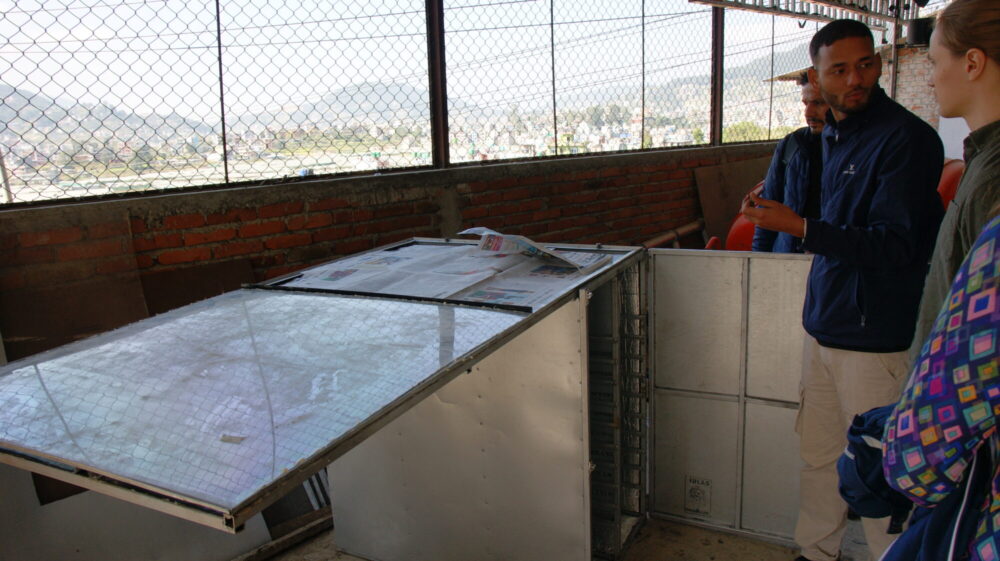
The new experimental version. Photo: Isabelle Hugøy
We also had the pleasure of meeting two Swedish MSc environmental engineering students from Lund University who focus on extensive measurements where different parts of the dryer are omitted or developed. These measurements will help the project team to understand cost optimization better.
The students shared some preliminary findings, including their reflections on lowering costs, improving user-experience, and the variations in taste of dried products in testing processes. Their findings will contribute to the continued development of improved and low-cost solar dryers.
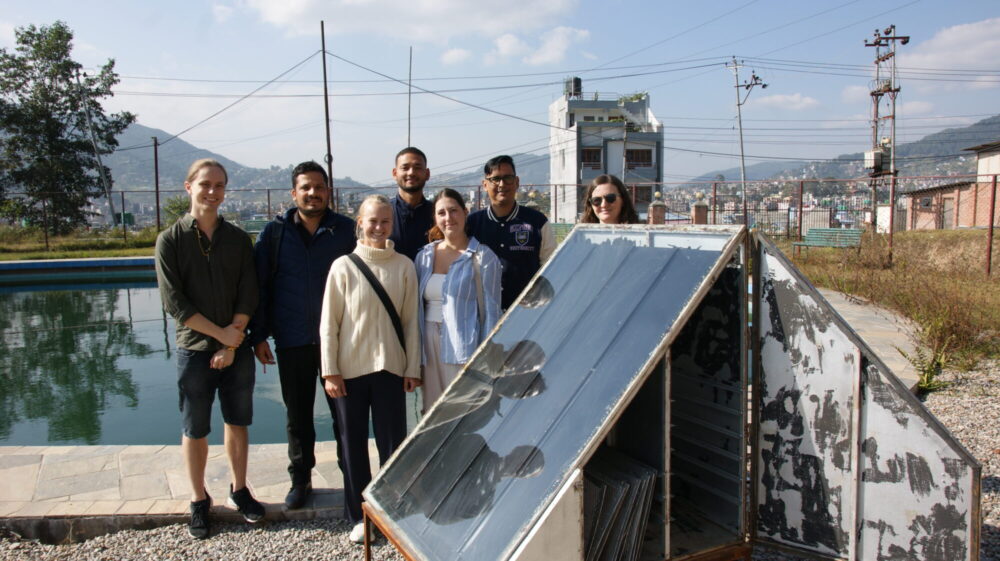
The two Swedish students show us the dryer they seek to improve. Photo: Isabelle Hugøy
Following this visit, the Norwegian, Nepali and Swedish team continued their trip to Bhutan. In Gedu, we met with Bhutanese partners, including Prof. Tshewang Lhendup from the Jigme Namgyel Engineering College (JNEC), and Dr. Tsagay and Kinley Yangdon, both from Gedu College of Business Studies (GCBS).
During the two-day workshop hosted by partners at GCBS, all participants gave a presentation of their respective project activities, and we discussed synergies between these before planning the upcoming fieldwork in Bhutan.
The leader of the SolarFood project, Prof. Pia Otte (Ruralis) and Assistant Prof. Roshee Lamichhane (KU) gave an introduction and training session on participatory methods that we were going to use during fieldwork with an agricultural cooperative in the Chukha district the following days. The same methods will be replicated in other selected study sites in both Bhutan and Nepal.
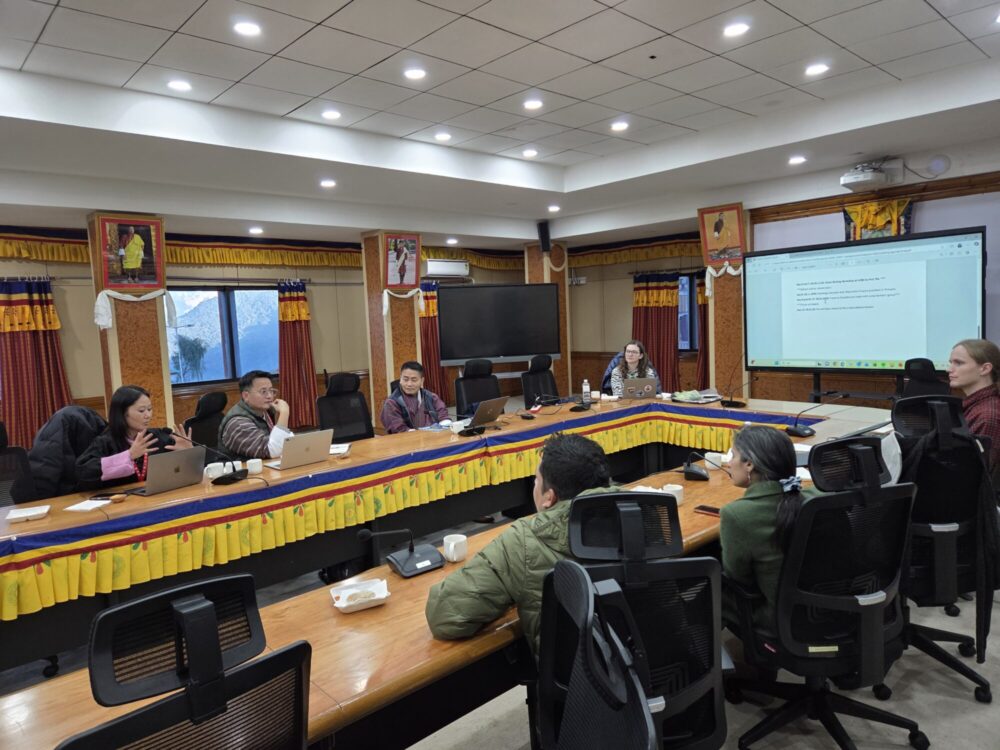
Workshop with partners at Gedu College of Business Studies. Photo: Isabelle Hugøy
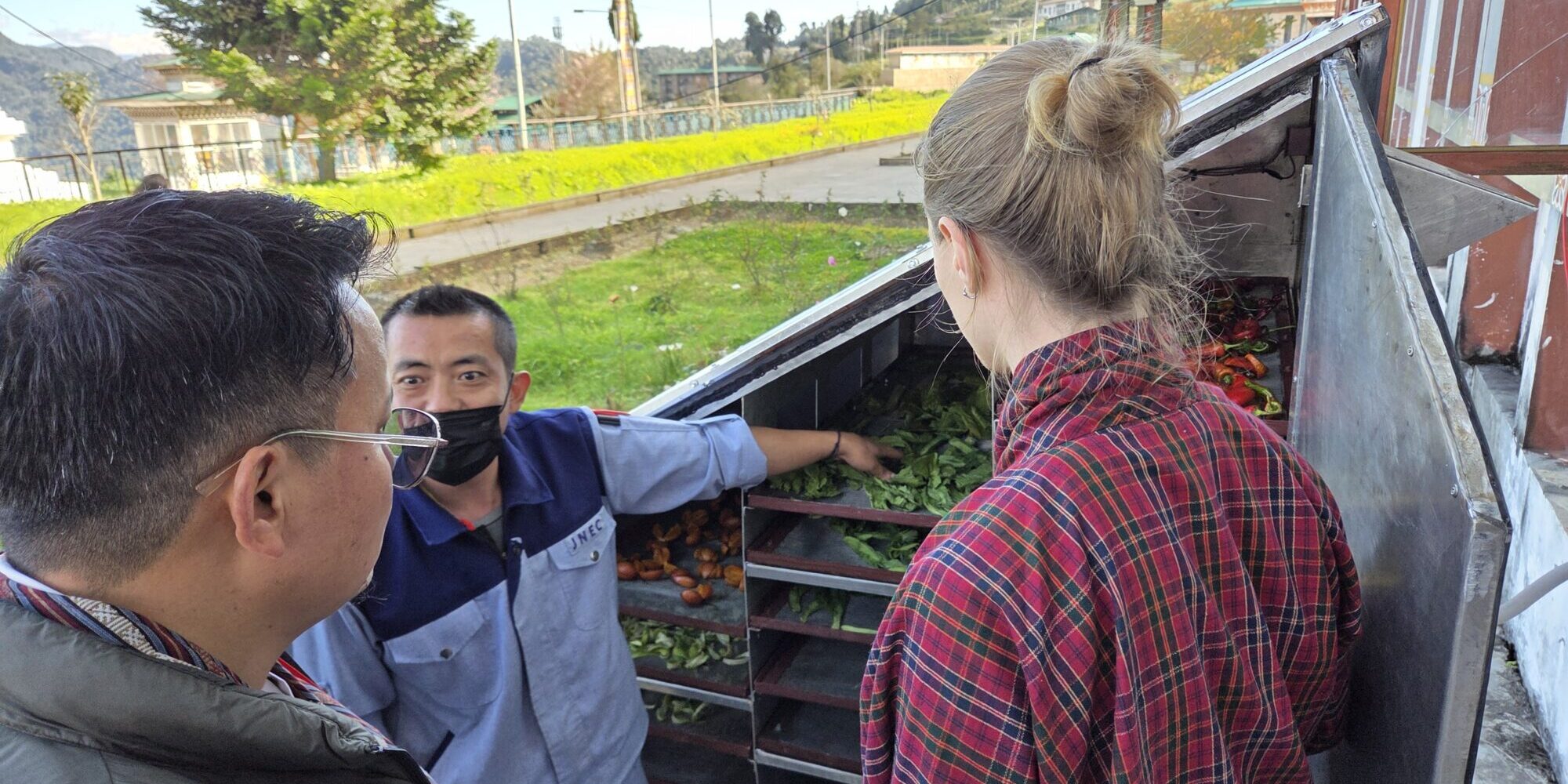
Another focus for discussion during the workshop was a prototype of a hybrid solar dryer that was recently developed by Jigme Namgyel Engineering College (JNEC). Its size and capacity were considerably larger than those we saw at Kathmandu University. Yet, the dryer’s current location at GCBS gave us the opportunity to organize a brief demonstration of it for a few selected farmers during the workshop.
We invited two local female farmers to bring vegetables of their choice. They cut them in slices and placed them on different trays in the dryer. Before starting the drying process, engineer Karma Tshechu from JNEC introduced the dryer, its capacity, function and drying process to the farmers who both paid careful attention.
He insisted that this technology produces dried foods with better taste compared to those dried traditionally on rooftops, where they are exposed to dust and pollution. This observation provides an interesting foundation for investigating the nutritional content of fruits dried using solar dryers.
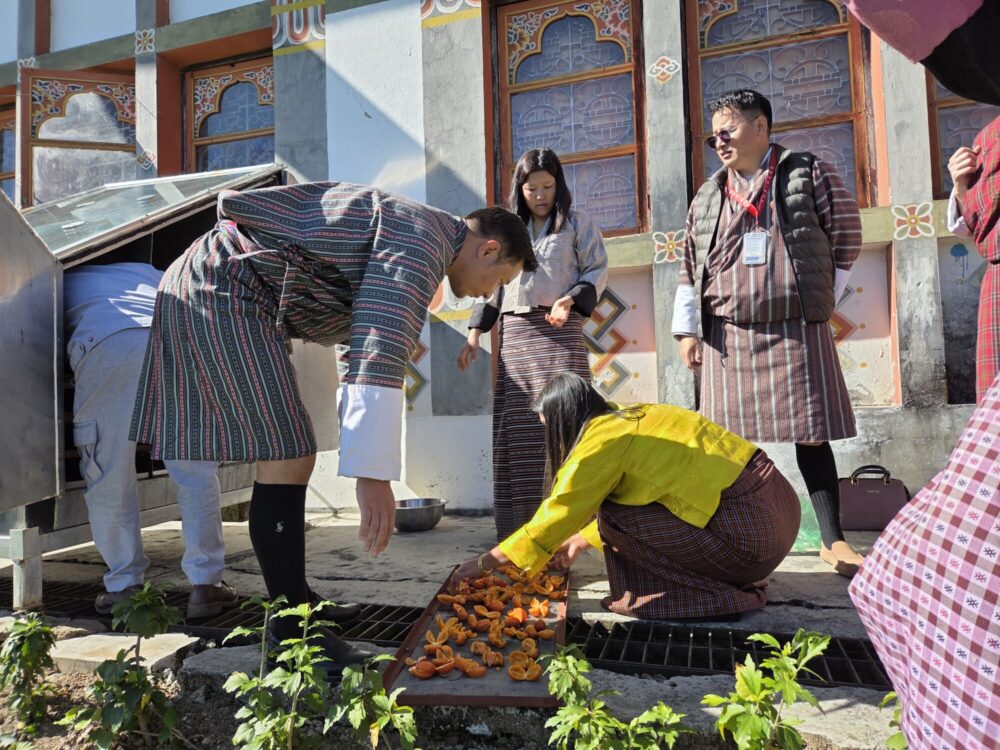
The farmers prepare vegetables for drying in the prototype. Photo: Isabelle Hugøy
Stay tuned for the next newsletter about the fieldwork in Bhutan.
Author
Published: 10 December 2025
Last updated: 11 December 2025