
Who Buys, Who Sells, and What Stands in Between: Fieldnotes from Nepal
Contact persons


Research areas
Share article:
What challenges do farmers face in their attempts to access markets? In this fieldnote, two master’s students who are associated with the SolarFood project share preliminary insights from their ongoing fieldwork among actors across the food value chain in the Kathmandu Valley and Pokhara in Nepal.
By Gustav Lautmann and Arvid Stider, Master’s students at Lund University
In February, we joined SolarFood researchers visiting the Saiti Mardi Kashi Agriculture Cooperative in Quibang, a 100-member cooperative growing ginger, cardamom, turmeric, and a range of vegetables in the hills outside Pokhara. We met with farmer members who have big visions and want to brand their products as organic and locally grown. But when we asked how they sell it, the picture became more complicated.
Farmers’ products go to distributors and on the distributor’s terms. Orders get cut without warning and unsold produce becomes the farmer’s problem to deal with. Farmers also lack market access and know-how to make the story of local organic produce reach the end consumers. A fundamental question that the cooperative is wrestling with is therefore: where is the product supposed to go, through which channels, and on whose terms?
This question is central to our thesis work. We have spent the past two months in Nepal working on the market side of the SolarFood project: mapping the value chain from producer to consumer, understanding what different buyers want, and identifying the conditions under which a go-to-market (GTM) strategy for solar-dried products could realistically work. Market access sits at the heart of SolarFood’s current work – no inclusive business model for solar drying can be complete without understanding who buys, at what price and under what conditions.
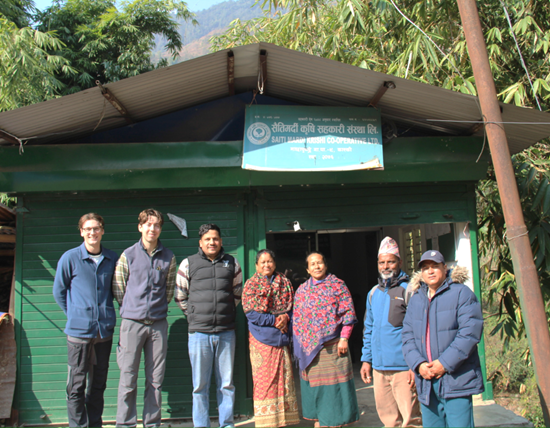
Saiti Mardi Kashi Agriculture Cooperative in Quibang. Photo: Arvid Stider
A fragmented value chain from farm to fork
Fragmentation across the value chain is a recurrent theme across our interviews. Producers are geographically scattered and disconnected from each other. Intermediaries operate locally with little coordination beyond their immediate networks. Institutional buyers like the UN World Food Programme (WFP) are not single national actors but collections of municipal procurement decisions spread across 77 districts.
In the retail sector there is also diversity. A specialist fruit shop in Pokhara buys in low volumes and relies on personal supplier relationships. By contrast, a Kathmandu supermarket chain procures centrally and often requires formal paperwork and consistent supply guarantees. Reaching both therefore requires two different routes to market. In addition, transportation of produce poses a challenge. Poor roads, construction, congestion, and unstable weather conditions make transport slow and time-consuming.
Aggregation is a primary bottleneck
Fragmentation has a practical consequence that has come up repeatedly: aggregation. Aggregation is the practice of collecting dispersed smallholder produce into volumes that commercial buyers will engage with. Our observation is that aggregation is costly, unreliable, and frequently avoided. Wholesalers and distributors told us they often prefer more predictable suppliers over the complexity of working with many small producers, even when the underlying product is good.
Private entrepreneurs face the same problems and frequently conclude that importing raw materials from India is simply easier than sourcing locally. For solar-dried products, this is a direct challenge. Solar drying technology requires reliable input volumes to justify investment. If the aggregation layer is broken before drying technology is implemented, adding drying capacity just moves the problem upstream.
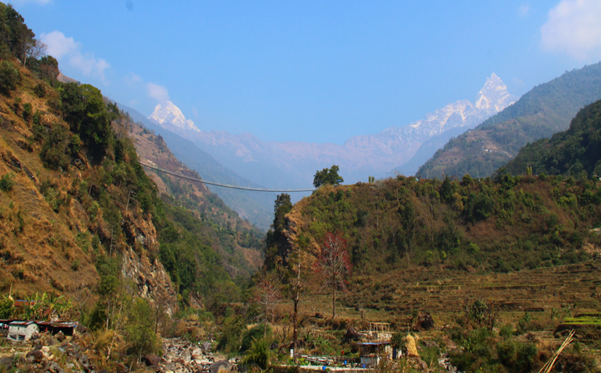
Quibang Valley with Annapurna I, Mardi Himal, and Machhapuchhre in the background Photo: Arvid Stider
Farmers have limited power in the food value chain
Farmers we spoke with stressed that they hold a weak position in their value chains. Several cooperatives and smallholder farmers described being price-takers with little room to negotiate, unable to forecast buyer demand, and regularly left holding unsold stock when orders were reduced at short notice. One cooperative told us that distributors simply set the terms, and farmers adapt or absorb the loss. This is a problem that cannot be neglected. Without targeted intervention in how value is distributed along the chain, farmers’ income improvement remains weak.
The domestic market for dried products is still forming
Even if the issues of aggregation and channel power were resolved, there is a demand-side challenge that remains. Among Nepali consumers, the market for processed dried food products is not yet established at a meaningful scale. An orange farmer outside Kathmandu described it plainly: the market is in an incubation phase. Consumers have not yet been convinced that locally dried fruit can substitute for other snack foods or fresh fruit.
This is not simply a matter of availability; it is a question of awareness and perceived value. This means that some degree of market-building, whether through branding, distribution partnerships, or targeted consumer segments, will need to be part of the picture when building a GTM strategy.
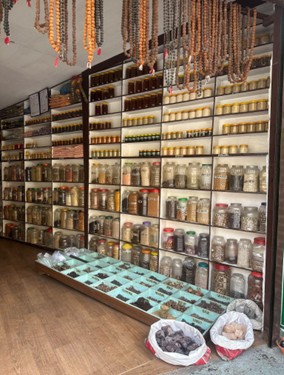
A small spice shop in Lake Side, Pokhara. Photo: Arvid Stider
Accessible markets are either niche or fragmented
Which market segments are accessible for farmers? This is a complicated question. Our fieldwork points in several directions. The tourist retail segment – specialty shops along the Pokhara lakeside and in similar tourist hubs – stocks dried products, and its customers actively seek locally produced, quality food. The buyer’s behaviour is clear and the willingness to pay is there. But the segment is geographically concentrated and limited in scale.
Institutional procurement, on the other hand, offers potential volume but turns out to be far more fragmented than it appears from the outside, with WFP being the clearest example. What looks like a single large buyer is, in practice, dozens of decentralised procurement decisions.
The local urban market – independent retailers and urban consumers – is also an interesting case and sits somewhere in between. It is more accessible than institutional procurement, but with consumer demand for dried products that is still forming.
The takeaway is the same: Throughout there is no uniform pathway into the markets. Strategy must be built segment by segment. Our research ambition is to develop a go-to-market strategy that is grounded in how the market functions, including its constraints and opportunities.
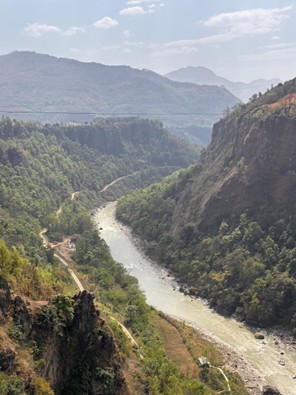
Photo: Gustav Lautmann
Gustav Lautmann and Arvid Stider are master’s students in Industrial Engineering and Management at Lund University (LTH). Currently, they are conducting fieldwork in Nepal in collaboration with the SolarFood project. Their thesis report will be published in June 2026.