
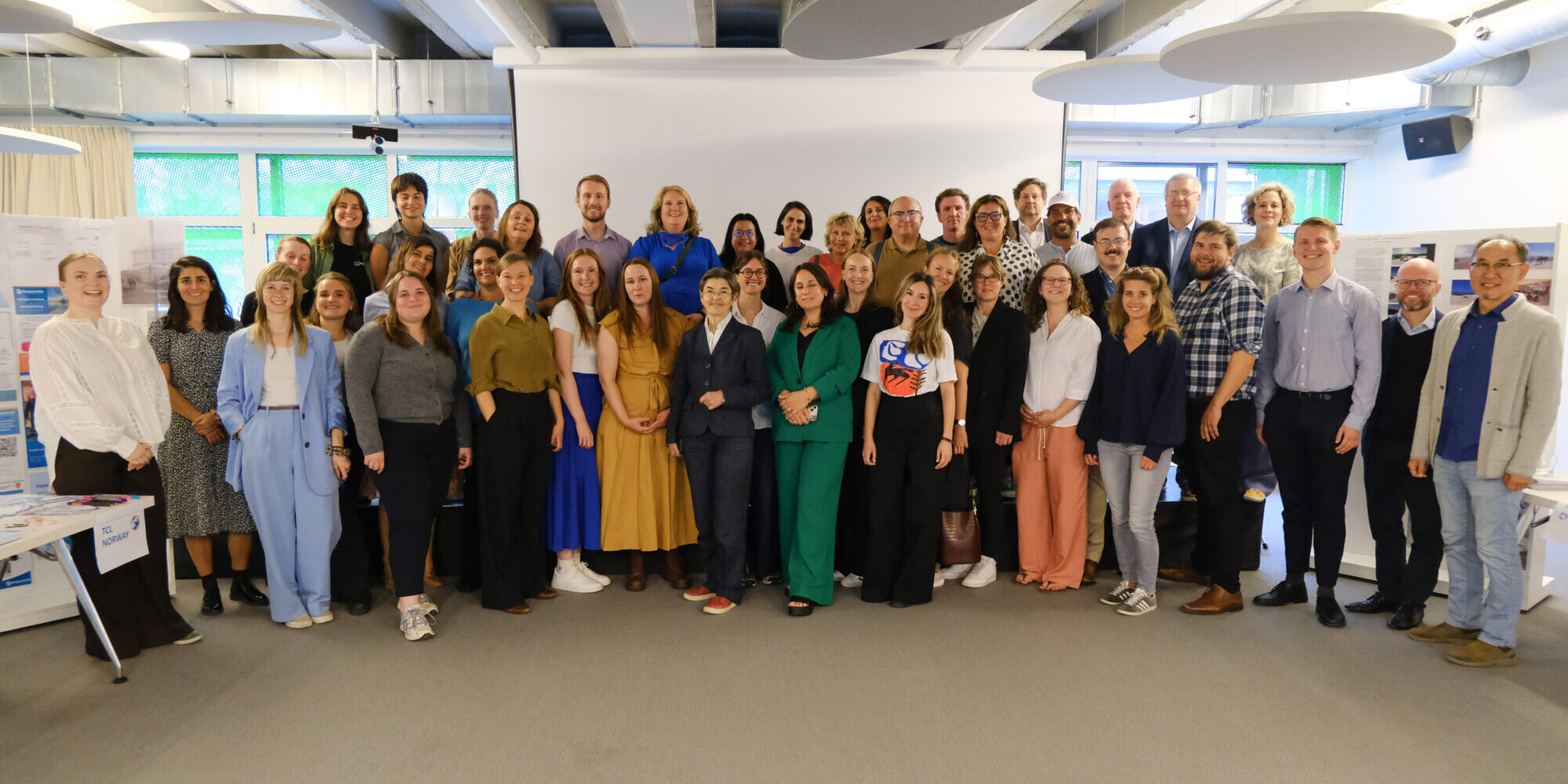
The Coastal Horizon Europe Research and Innovation project EmpowerUs has come to an end!
Author
Published: 23 October 2025
Last updated: 23 October 2025
Contact persons

Share article:
EmpowerUs has been a three-year project exploring the “Socio-economic Empowerment of coastal communities as users of the sea to ensure sustainable coastal development”. The project has been funded by the EU Horizon programme and coordinated by Nordland Research Institute.
The project has focused on supporting six “Transition Coastal Labs” in Burgas (Bulgaria), Åland (Finland), Eastern Limassol (Cyprus), Connemara and the Aran Islands (Ireland), Træna (Norway) and Cap de Creus (Spain). Together with these local communities, research communities and local organisations have co- developed and implemented pilot projects that have sought to redirect the Blue Economy to support a thriving coastal community.
Ruralis’ role in the project has been twofold as we have: 1. acted as the Gender and Diversity Coordinator for the project, and lead its Gender and Equity Board; 2. led two tasks in Work Package 5 that has focused on developing a Handbook of Inclusive Methodologies for the project.
In addition to participating in cross-project collaborations ( https://empowerus-project.eu/results/) the work of Ruralis has resulted in three main deliverables:
Handbook
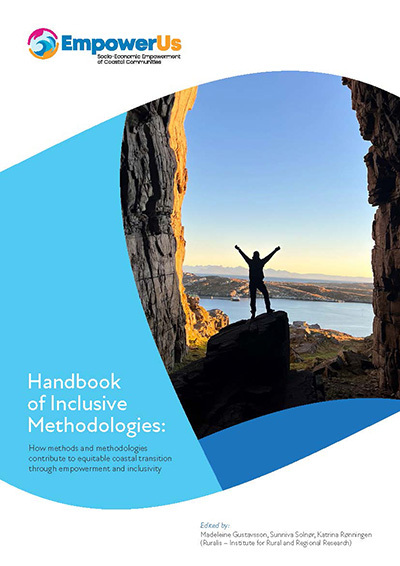
Frontpage of the handbook
The Handbook brings together a variety of reflections on some of the challenges, strengths, lessons learned, and broader insights for how to use and develop methods and methodologies for community projects and initiatives to reach broader goals around inclusivity and equity.
Many researchers will be familiar with a lot of the methods and methodologies explored in the Handbook. However, most are likely to be unfamiliar with the specific enablers and challenges of implementing such approaches in practice to ensure inclusivity and equity in (coastal) transitions, which are explored in detail in the Handbook. Also, many coastal practitioners are aware of the importance of inclusivity and equity in coastal transitions. However, when implementing initiatives themselves, they often lack experience in designing initiatives that ensure inclusive processes and outcomes for coastal communities.
The key findings presented in the Handbook, in relation to ensuring equitable and inclusive coastal transitions, can be adopted and applied in future research and innovation projects concerned with coastal community transitions. The Handbook can also be used by those working with coastal communities on the ground to ensure that their projects and initiatives are equitable and inclusive.
Please see our Executive summary of the Handbook for a shorter read.
Gender, Equality and Diversity Plan
Gender, Equality and Diversity Plan (doi:10.5281/zenodo.14193169).
The Gender, Equality and Diversity Plan provides background to key research on gender, diversity, and intersectional issues in marine and coastal community contexts and develops an approach to be implemented across the project.
Policy brief
Policy Brief: An Equitable Ocean Pact? Leaving No One Behind in Just Coastal Community Transitions
This policy brief demonstrates experiences from EmpowerUs in which we actioned the Leaving No One Behind principle in six Transition Coastal Labs (Bulgaria, Cyprus, Finland, Ireland, Norway and Spain). We explored the specific ways to understand and operationalise the principle of Leaving No One Behind, highlighting multiple forms of coastal communities’ transitions and what they grapple with.
Based on reflection interviews with TCL partners conducted throughout the project, the analysis reveals multiple forms and interpretations of One in ‘Leaving No One Behind’—uncovering different ideas of equity—and highlighting tensions, trade-offs and the need to negotiate and balance perspectives within and among different LNOB forms.
The brief argues for the need to reflexively negotiate leaving no people(s), places, livelihoods and ecologies behind for coastal community resilience, wellbeing and just transitions.
Ruralis has also participated in co-authoring a number of journal articles that have already been published during the lifetime of the project:
Antonova A. Flannery W., Gomez S., Gustavsson M., Hadjimichael M., Murtagh B., Ounanian K., Solnør S., Steiro V.M. og Svels K. 2025 “Blue community economies: Centring coastal communities’ diverse economic practices in the Blue Economy” måltidsskrift: Geoforum 166 (104410) https://doi.org/10.1016/j.geoforum.2025.104410
Sørensen J., Ounanian K., Becker Jacobsen R., Ekstedt J., Solnør S.M., Ronningen K., Gomez S., Hadjimichael M., Flannery W., Svels K., Antonova An., Steiro V.M.D., and Gustavsson M. 2025. Stepping stones as metaphor for building partnerships and co-producing knowledge in coastal transitions. Local Development and Society. https://doi.org/10.1080/26883597.2025.2528014
Thank you all for your participation
We hope to see more collaborative results coming out of the project and for the Transition Coastal Labs that were fundamental to the project’s success to continue with their important work past the lifetime of the project. We wish to express our thanks to all project partners but in particular to our Work Package 5 collaborators at Centre for Blue Governance Aalborg University and the project coordinators Nordlandsforskning based in Mo i Rana, Norway. We will miss all of you and hope to continue our important work in future projects.
Author
Published: 23 October 2025
Last updated: 23 October 2025